

Considered Practice
The Unhurried Hour and Its Place in a Structured Weekly Cadence
Tobias Allenby·
·11 min read

For fourteen weeks, between November and late February, a single practice was observed: to open a notebook within the first ten minutes of waking, and to record — without editing or filtering — the sequence of what happened in the following hour. The results were not dramatic. But they were, on reflection, illuminating.
The distinction matters. A great deal of contemporary writing on morning routines positions the early hour as a productivity lever — a period to be engineered for maximum downstream output. That framing, while intuitive, tends to introduce a self-consciousness into the first hour that distorts what the first hour actually is. The agenda of observation is different. When a writer sits down with a notebook not to plan but simply to document, a different quality of attention becomes possible.
Sleep researchers have observed that the period immediately after waking involves a gradual shift in cortical activity — a transition that, depending on the quality of the preceding night, can feel either fluid or effortful. The notebook did not attempt to accelerate this shift. It simply recorded it: whether the waking was sharp or gradual, what the first physical sensation was, whether the mind arrived all at once or assembled itself in parts.
Over time, that record became a data set of sorts. Not a scientific one — the methodology was personal and uncontrolled — but a useful one. Patterns became visible that no single morning, considered in isolation, would have revealed.
The clearest finding, if the word applies, was the relationship between the character of the first hour and the durability of physical engagement during the afternoon. On mornings when the notebook entry ran long — when there was something to observe, some texture to the waking — afternoon movement tended to be easier and more sustained. On mornings recorded in three lines, the afternoon often contracted.
This is not a causal claim. Any number of variables — sleep duration, room temperature, prior-day exertion, ambient light — contribute simultaneously. But the correlation was consistent enough to warrant attention. The notebook seemed to function as an early-morning calibration: a brief period of deliberate presence that established something like a baseline tone for the hours following.
The physical dimension of this was specific. Entries on mornings that preceded good afternoon energy frequently noted early-morning movement of some kind — not structured exercise, but ordinary physical activity: opening windows, making tea while standing rather than sitting, stretching briefly before reading. None of these were planned. They appeared to arise naturally on the mornings when the first hour was being observed rather than used.
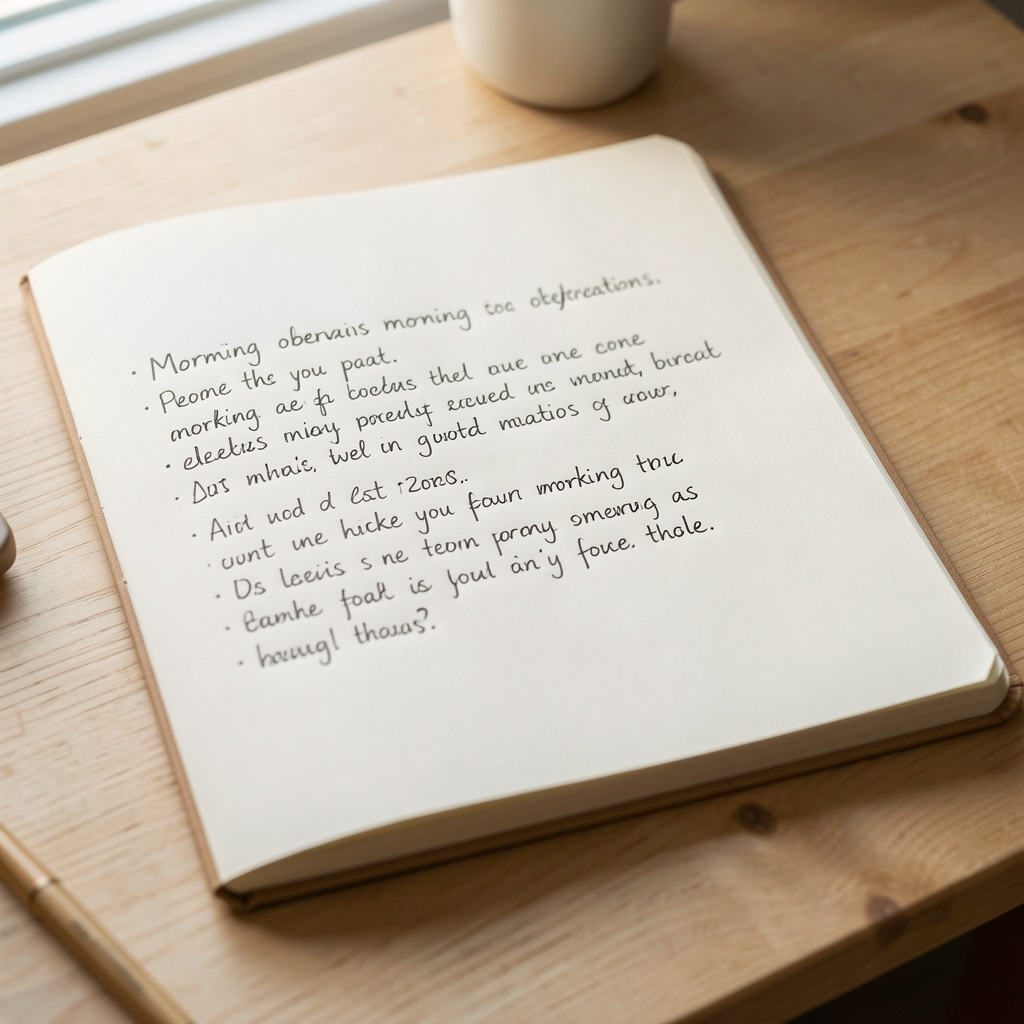
Published research on what is variously described as attentional focus, mindful awareness, and present-moment engagement tends to suggest that deliberate attention practices — even brief ones — have a measurable effect on subsequent cognitive performance. The mechanism proposed most consistently involves a reduction in what researchers term mind-wandering: the tendency of the unoccupied mind to shift between past and future scenarios in ways that consume attentional resources without producing any particular output.
The notebook practice was, in retrospect, a form of this. Not a formalised mindfulness sequence, but a functional equivalent: a deliberate act of present-moment attention that occupied the mind with something specific during the transitional first minutes of the day. The act of writing, even when what was written was mundane — the quality of the light, the sounds in the street, the sensation of cold floors — required a particular kind of attentional commitment that the passive scrolling of a phone does not.
Several weeks into the practice, a change was noticeable: the entries began to move, unprompted, toward plans for physical activity later in the day. Not structured plans with times and targets — something looser than that. Notes that a walk might be useful, or that the afternoon's work would benefit from a pause. Whether or not those observations were acted upon, the act of noticing seemed to increase the likelihood of physical engagement.
"The notebook did not make the mornings better. It made the mornings visible. Visibility, it turned out, was the more useful quality."
The fourteen weeks of this observation spanned the period of lowest light in a London winter. This is worth noting because seasonality exerts a recognised influence on physical vitality — daylight duration, ambient temperature, and the disruption of outdoor-dependent routines all intersect in the winter months. The expectation, when the notebook practice began in November, was that entries would become sparser and more negative as the winter deepened.
That did not consistently happen. By January, the entries were longer and more precise than they had been in November. Whether this reflected an adaptation to the season, the developing practice of recording, or simply the compounding effect of weeks of deliberate morning attention is impossible to determine. The trend was nonetheless notable: sustained attention to the morning hour appeared to have some buffering effect against the seasonal contraction of energy that usually characterises the deepest winter weeks.
Other observers have reported similar patterns. Writers who maintain daily journals, practitioners of morning seated reflection, and participants in structured morning-movement programs all describe an improved relationship with early waking that tends to develop gradually over the first four to six weeks of a new practice. The notebook offered a partial confirmation of this pattern in a non-specialist, ordinary-life setting.
Fourteen weeks is a limited observation window. The practice ended not because it stopped being useful but because the winter did — the lengthening of mornings in late February introduced a different light quality that made the notebook feel less necessary, or perhaps that the attentional habit it had built had begun to operate without the support of the physical act of writing. Whether that is an accurate reading or a rationalisation is difficult to say.
What was not resolved by the notebook was the question of mechanism. The correlation between morning attention and afternoon physical energy is the central finding of this observation, and it remains unexplained in any rigorous sense. The hypothesis that deliberate present-moment attention in the morning establishes a attentional set that persists through the day is plausible and consistent with what published research describes. But it has not been tested here, only suggested.
The second notebook will open in autumn, when the light contracts again. The records from the fourteen-week winter practice will be available for comparison. Whether the patterns repeat, change, or disappear entirely will be the next entry in this particular ongoing field observation.