

Morning Cadence
What a Season of Slow Mornings Documented in a Working Notebook
Harriet Marsden·
·9 min read

The most productive weeks in this contributor's record are not the weeks with the most filled hours. They are, consistently, the weeks that contained at least one hour in which nothing particular was scheduled — an hour that was not rest in any passive sense, but that was deliberately held open, resisting the pressure to be used.
There is a persistent assumption in contemporary writing on productivity and active living that the optimised week is the full week — that every hour accounted for is an hour well spent. The research literature on cognitive performance and sustained physical engagement suggests a more nuanced picture. Periods of deliberate non-scheduling appear to function as structural elements in a well-maintained weekly rhythm, not as gaps between the functional parts.
The distinction between an unscheduled hour and a rest hour is not a small one. Rest, in the sense usually meant, is recuperative — it follows exertion and precedes further exertion. The unhurried hour described here is categorically different: it is neither preceding nor following in any deliberate sense. It sits in the week without a functional relationship to what comes before or after. Its value, the observation suggests, is precisely its independence.
Researchers studying what is sometimes described as default-mode cognition — the mental activity that occurs in the absence of directed tasks — note that this mode of thinking is associated with integration of recent experience, spontaneous problem-solving, and the formation of longer-term personal intentions. These are not trivial outcomes. They are, in fact, the outcomes that the busiest weeks consistently fail to produce.
The practice described here ran across eleven weeks in January and February 2026. Each week, one hour was designated as unhurried. The designation was made at the start of the week, in a weekly planning entry, and the time was identified — typically mid-morning on a Wednesday or Thursday, when the week's energy tends to be most settled and neither the opening momentum of Monday nor the closing pressure of Friday applies.
During the designated hour, no screen-based activity was undertaken. The hour was not used for reading in any directed sense. Walks were permitted, as was sitting near a window, handling physical objects, or simply existing in the room without an agenda. The only rule was the absence of scheduled activity. What the hour contained was determined by nothing more formal than inclination.
This is not a novel practice. Writers, painters, and composers have described analogous routines across a wide range of historical contexts. What is perhaps underexplored in the contemporary literature on active living and physical wellbeing is the relevance of this kind of open-structured time to physical, rather than purely cognitive, outcomes.

Across the eleven weeks, a consistent pattern was noted in daily entries: the afternoons following unhurried-hour mornings were more likely to include physical activity than the afternoons following fully scheduled mornings. The activity was rarely intense in any formal sense — it was more often a longer walk, a less abbreviated stretching sequence, or an inclination to take stairs rather than standing in a lift. The difference was not in what was done but in the quality of willingness with which it was done.
This aligns with what published research on decision fatigue and volitional energy describes: the capacity to initiate and sustain self-directed behaviour depletes across the day in proportion to the number and difficulty of prior decisions made. A morning containing fewer active decisions — which is precisely what the unhurried hour creates — may preserve a larger reservoir of volitional energy for use in afternoon activity, even when total rest time is unchanged.
The implication is not that less activity in the morning produces more activity overall, but that the character of morning activity — its degree of deliberateness, its demands on attention and choice — influences the afternoon's available energy for physical engagement.
"The unhurried hour is not absence of activity. It is the presence of a particular kind of attention — one that does not ask anything of itself, and in not asking, replenishes something."
Placement within the week matters. The observation across eleven weeks suggested that the unhurried hour is most effective when positioned neither at the very beginning nor the very end of the working week. The beginning of the week carries its own kind of attentional load — the assembling of intentions, the prioritising of tasks, the carrying forward of unfinished items from the previous week. The end of the week carries its own pressure: the drive toward closure, toward the weekend, toward the particular relief of completing a cycle.
Mid-week placement — specifically Wednesday and early Thursday — consistently produced the most legible effect in the subsequent entries. The afternoons of those days, and the days following, appeared in the record as more physically active, more considered in their sequencing, and notably less contracted in their scope than the mid-weeks of fully scheduled periods.
This placement also corresponds to a point in the weekly energy cycle that several researchers have described as a characteristic mid-week low — a period when the initial momentum of Monday has dissipated and the proximity of the weekend has not yet arrived. The unhurried hour in this position may function as a partial reset within the cycle.
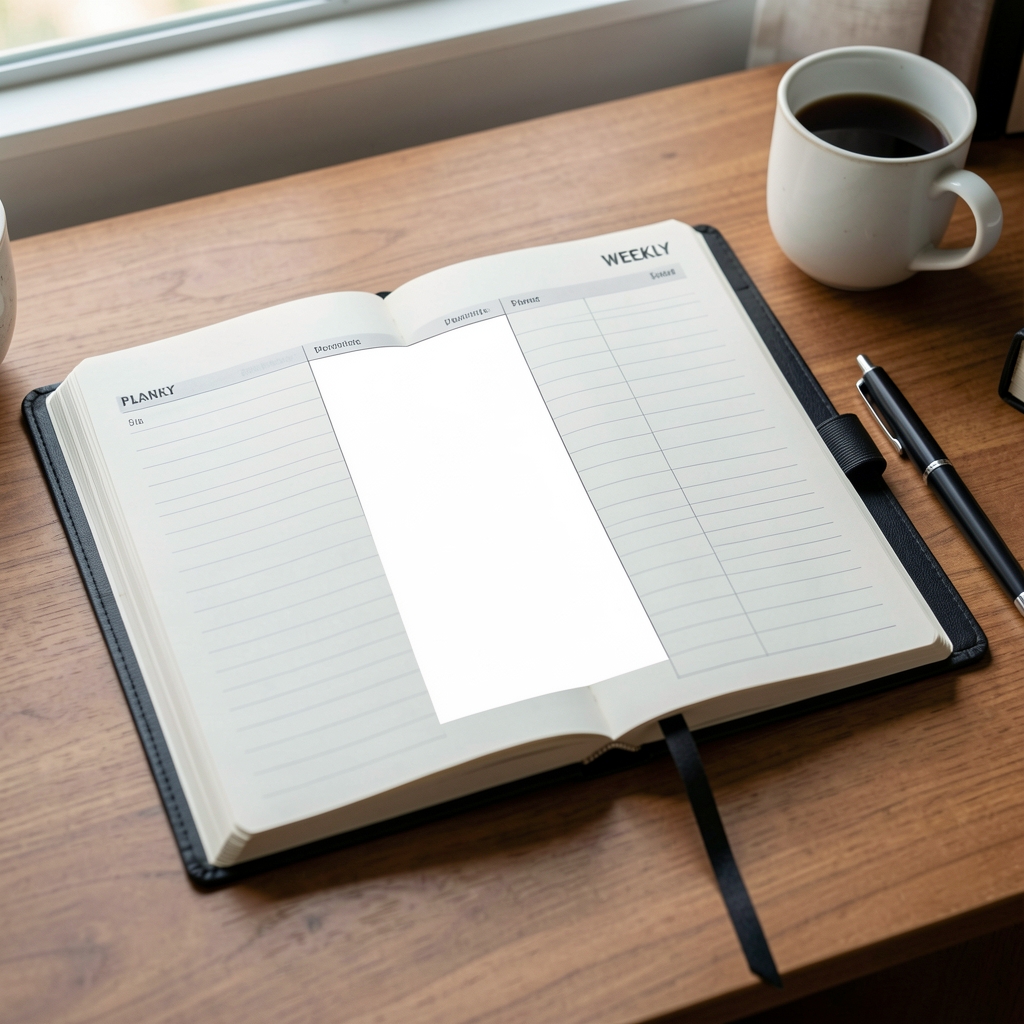
In practice, maintaining the unhurried hour is not straightforward. The pressure to fill available time is consistent and comes from multiple directions simultaneously — from professional obligation, from the ambient anxiety that unoccupied time is wasted time, and from the small habitual reaches for stimulation that a phone-in-pocket daily life makes constant. The resistance encountered in attempting to hold an hour open reveals something about the degree to which unscheduled time has been edited out of contemporary daily rhythms.
The resistance is itself informative. On the weeks when the unhurried hour was most difficult to protect — when meetings encroached, when an email demanded a response, when the hour contracted to forty minutes or was moved to a marginal position at the end of the day — the subsequent physical entries were notably thinner. The relationship between protected open time and subsequent physical engagement appears to depend on the integrity of the protection, not merely the fact of the attempt.
This observation is practically relevant: the unhurried hour is not a passive practice that can be approximated. It requires an active decision, made at the beginning of each week, to hold time against the many legitimate-seeming demands that will otherwise absorb it.
It is worth being clear about what is not being claimed here. The unhurried hour is not a restorative practice in the specialist or structured sense. It is not a form of seated attention practice, nor is it yoga, nor is it sleep. It does not involve breath control, guided imagery, or any formalised sequence. Its defining characteristic is the absence of such definition.
Equally, it is not a productivity technique of the kind that populates the contemporary genre of organisational self-improvement. The aim is not to emerge from the hour with better ideas or increased motivation for the tasks ahead. The aim, to the extent that the word applies, is simply to sustain a weekly rhythm that contains, among its several elements, one period of genuine openness.
Whether eleven weeks constitute sufficient observation to draw anything more than provisional conclusions is a fair question. The intention is to continue the practice and to extend the record. What is already clear is that weeks containing the unhurried hour look and feel different — in the record, and in the body — from the weeks that do not.